Koralm Tunnel, contract section KAT3
St. Paul im Lavanttal, Austria / 11.2013 - 07.2020
Together with the Semmering Base Tunnel and the newly constructed Vienna Main Station, the Koralm Railway marks another key structure along the Baltic-Adriatic corridor which is supposed to connect the individual regions and emerging economic areas between the Baltic Sea and the Adriatic.
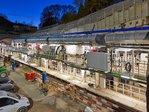
Along this route, the 32.9-km-long Koralm Tunnel will cross the Koralpe mountain range with up to 1,200m of overlying strata by summer 2020. The two tunnel tubes run parallel to each other at a distance of about 25 to 50m apart and are connected to each other every 500m with cross passages. PORR has been working on the third contract section of this tunnel project since late 2013.
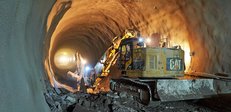
Due to varying geological conditions, different construction methods are used in its implementation. Thus, the southern tube’s entire length is tunnelled using cyclic tunnel boring, while the rest up to the second contract section’s border is driven using the entire cross-section. The north tube is predominantly drilled mechanically. Only the exploratory tunnel and the TBM launch tube are drilled conventionally. The northern and southern tubes’ inner shells also have to be installed differently to meet the varying geological and water pressure conditions. Thus, the southern tube is built using in-situ concrete, while tubbing segments are used to finish the northern tube.

Facts & Figures
Company
PORR Bau GmbH
Type
Tunneling
Runtime
11.2013 - 07.2020
Austria’s longest railway tunnel
One of this project’s special features is the disassembly cavern dug for the tunnel boring machine of contract section 2 whose construction is also part of PORR’s scope of services and whose size was optimised in collaboration with the client in the course of construction execution. To be precise, the cavern’s cross-section could be reduced from 354 to 170m² which saved a lot of time and material.
The tunnel boring machine used for contract section 3 is 240m long and was equipped for all predicted conditions in the mountain. A modular system allows for the machine’s swift conversion to the respective current composition of the rock below ground.
The entire route is scheduled to be completed in 2023, at the latest. Then, the first trains will speed through the Koralm Tunnel’s two tubes at up to 250 kilometres per hour.