A99 motorway bridge
Munich, Germany / 12.2017 - 10.2019
By demolishing and rebuilding two motorway bridges over the Isar Canal, PORR made a significant contribution to the eight-lane expansion of the A99 near Munich. The infrastructure project was carried out whilst traffic continued to flow on one of Germany’s busiest motorways, combining challenging bridge construction with high environmental and architectural standards.

Facts & Figures
Company
PORR Bau GmbH
Type
Bridge construction
Runtime
12.2017 - 10.2019
Demolition and reconstruction of the A99 motorway bridges over the Isar Canal
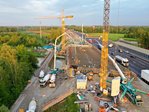
The two existing bridge structures formed a central section of the expansion project between the München-Nord junction and the Haar junction. Due to the high volume of traffic – up to 170,000 vehicles per day – all work had to be carried out whilst traffic continued to flow. At the same time, the location above the Isar Canal posed particular challenges for the demolition of the existing structures, as neither the water quality nor the existing concrete channel could be compromised.
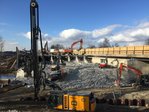
To ensure the work was carried out safely, PORR developed a special, reusable demolition and working scaffold. This innovative design enabled the demolition of the existing bridges and the construction of both new bridge structures using a single scaffolding solution. This optimised construction processes and ensured resources were used efficiently.
Environmentally sustainable implementation in a sensitive natural area
In addition to the structural engineering challenges, the protection of the surrounding natural environment played a central role. The construction site area was home to the habitats of several bat species, whose flight paths had to be preserved throughout the entire construction period. Specially developed protective measures and continuous monitoring ensured that the animals could pass through the construction site undisturbed, even during night-time work.
The proximity to the Feringasee recreational area led to high design requirements for the new bridge structures. Characteristic features include the conically sloping piers, rounded pier heads and the parabolic-shaped longitudinal girders, which blend harmoniously into the surroundings. Achieving this complex geometry required bespoke formwork solutions and the utmost precision in both planning and execution. The exposed concrete surfaces were also constructed in accordance with strict architectural specifications.
Optimised logistics and precise execution
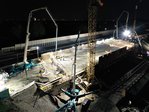
Another key factor in the project’s success was the precise organisation of the concrete pouring work. For each structural element, around 1,800 m³ of concrete was poured in a single pouring phase. As the concrete had to be delivered to the heavily congested Munich metropolitan area, the work was carried out predominantly at night. Four large concrete pumps with reaches of up to 70 metres ensured continuous placement and the required concrete quality across the entire structure.
Despite the complex requirements, the first bridge structure was fully concreted just seven months after construction began. Following the successful diversion of traffic, the second bridge structure was also completed on schedule. Subsequently, PORR also took on the design of the traffic and open spaces beneath the bridges, including new access roads, footpaths and cycle paths, as well as landscaping measures along the canal.
With around 9,000 m³ of concrete used, approximately 1,300 tonnes of steel and two bridge structures each around 80 metres long, the result is a high-performance infrastructure project that sustainably improves the traffic situation in the Greater Munich area whilst meeting the highest technical, logistical and environmental standards.